Helping to preserve our natural resources!
Taney County Regional Sewer District
From a 1983 ballot measure to serving 4,400 customers today
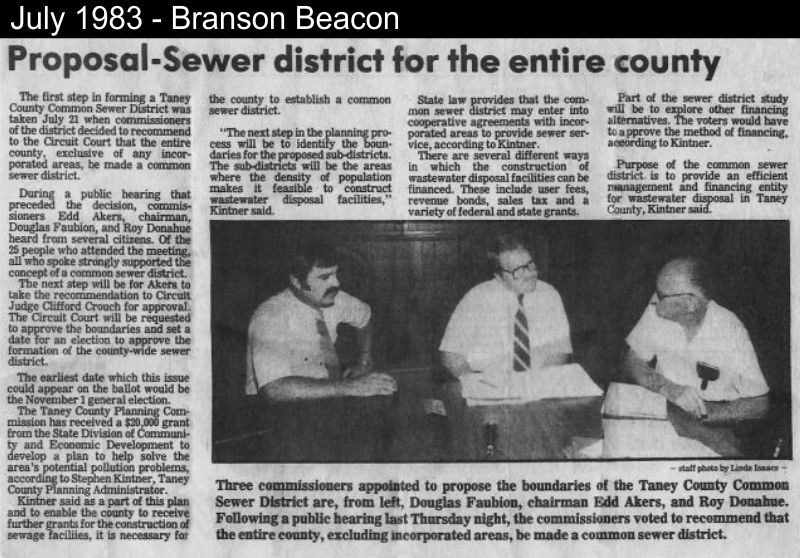
Proposed Sewer District boundaries as presented to voters — November 8, 1983
From a regulatory agency to a full-service utility district
Four decades of protecting Taney County's waters
Taney County sits in the heart of the Ozarks in southwestern Missouri. Within its 652 square miles lie Table Rock Lake, Lake Taneycomo, and Bull Shoals Lake, along with more than 70 rivers and streams — all drained by the White River and its tributaries.
With so much water woven through the landscape, protecting it from pollution wasn't just good policy. It was essential.
The founding declaration of the District has never been more relevant:
On November 8, 1983, Taney County voters went to the polls on a special proposition to form a countywide sewer district. The measure passed decisively, and the Taney County Regional Sewer District was formed under Missouri State Statute Chapter 204.
The proposition was requested by the Taney County Court (now the Taney County Commission). A special commission defined the district boundaries, and the Circuit Court subsequently issued a decree setting those boundaries to encompass all of Taney County.
The Circuit Court Decree of December 15, 1983 directed the Taney County Commission to appoint five people as Board of Trustees to control and operate the new Sewer District.
The first Board of Trustees convened on January 3, 1984 — marking the official beginning of the District's operations. Trustee terms are five years, staggered, and members may be reappointed.
For the first decade, TCRSD operated primarily as a regulatory agency — approving onsite septic systems, reviewing developer projects, investigating complaints, and inspecting approximately 140 private package treatment plants throughout the county.
Water quality monitoring was also underway: monthly samples were collected from county lakes and streams and sent to Springfield for laboratory testing, establishing an early baseline for the county's water quality.
1993 was a pivotal year for the District. Taney County voters approved a ½ cent sales tax dedicated entirely to funding sewer projects throughout the county with the first sewer projects being constructed in the mid-1990s just outside the city limits of Hollister. Currently the Sewer Sales Tax generates close to $12,000,000 per year, providing the financial foundation for the protection of Taney County’s drinking water, lakes, and streams.
In 2012, the Taney County Regional Sewer District became a fully independent political entity — separate from Taney County government. The utility portion of the District is funded through service fees, capacity fees, and inspection fees.
As of 2026, the District operates with an annual budget of $ 3.9~ Million and a team of 15 staff members across administration, construction, operations, field services, and computer systems.
The District now operates 15 collection systems comprising 55 lift stations and 5 treatment plants, with infrastructure spanning 101 miles of gravity lines, 35.2 miles of force main, and 23.9 miles of low-pressure lines — serving approximately 4,400 residential and commercial customers across Taney County.
The District continues to expand, modernize, and deliver on the promise made to Taney County voters back in November of 1983.